High Quality OEM/ODM LED Strip Manufacturer
High Quality OEM/ODM LED Strip Manufacturer
March 28, 2026 686
CRI (Color Rendering Index) is a measurement of how accurately a light source reveals the true colors of objects compared to natural light. In LED strip lighting, CRI directly affects how materials, surfaces, and products appear to the human eye.
A higher CRI means colors look more natural and vibrant, while a lower CRI can make objects appear dull, washed out, or even distorted. For most professional lighting applications, CRI is not just a specification—it is a critical factor in visual quality and user experience.
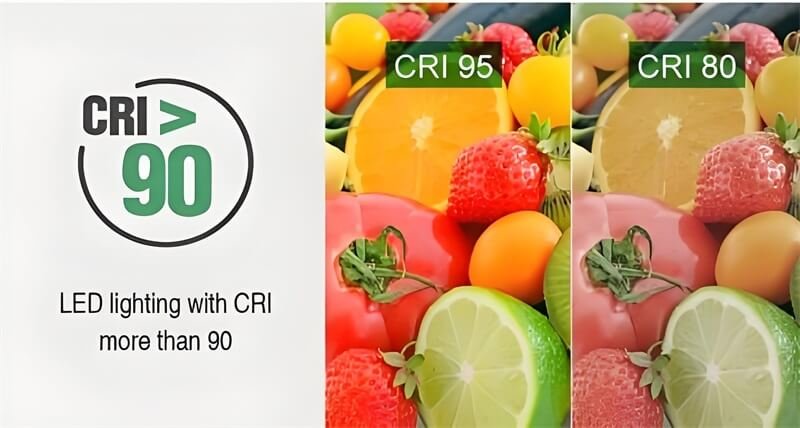
CRI is measured on a scale from 0 to 100. The closer the value is to 100, the better the color rendering performance.
| CRI Range | Performance Level | Typical Application |
|---|---|---|
| 60–70 | Poor | Basic industrial or outdoor lighting |
| 70–80 | Acceptable | General lighting with low visual demand |
| 80–90 | Good | Residential and commercial spaces |
| 90–95 | Excellent | Retail, hospitality, high-end interiors |
| 95–100 | Premium | Museums, galleries, luxury environments |
In most architectural and commercial projects, CRI 80 is considered the minimum standard. However, high-end environments increasingly require CRI 90 or above to ensure accurate color presentation.
The impact of CRI becomes especially noticeable in environments where color accuracy matters.
In retail spaces, poor CRI can alter the appearance of products, affecting purchasing decisions. In hospitality settings, it can influence the perceived quality of materials such as wood, fabric, and finishes. In residential environments, it directly affects comfort and visual warmth.
From a technical standpoint, CRI reflects how well a light source reproduces a set of standardized color samples. However, in practical terms, it determines whether colors look natural, vivid, or distorted under artificial lighting.
It is also important to understand that CRI does not measure brightness. A light source can be very bright but still have poor color rendering. This is why CRI must always be evaluated alongside lumen output and color temperature.
CRI is often confused with other lighting metrics, but each serves a different purpose.
Color temperature (CCT) describes whether light appears warm or cool, measured in Kelvin. It affects the mood of a space but not color accuracy.
Luminous flux (lumens) measures brightness. It indicates how much light is emitted, but not how well colors are rendered.
In advanced lighting design, CRI works together with these parameters to define overall light quality. For example, a warm white LED strip with high CRI can create a comfortable and natural atmosphere, while a cool white strip with low CRI may feel harsh and unnatural.
Selecting the appropriate CRI depends on the function of the space and the expectations for visual performance.
For general residential lighting, CRI 80 is usually sufficient. It provides acceptable color rendering for everyday use without significantly increasing cost.
In commercial environments such as offices, restaurants, and hotels, CRI 90 is often preferred. It enhances material textures and improves the overall visual experience.
Retail environments, especially those involving clothing, cosmetics, or fresh products, benefit significantly from CRI 90 or higher. Accurate color representation can directly influence customer perception and sales.
In specialized environments such as galleries or luxury showrooms, CRI 95+ is recommended to achieve the highest level of color fidelity.
One of the most common questions is whether higher CRI always means better lighting. In most cases, higher CRI improves visual quality, but it may also come with higher cost and slightly lower efficiency. The choice should be based on application needs rather than simply selecting the highest value.
Another frequent concern is whether high CRI affects brightness. In practice, high CRI LEDs may have slightly lower luminous efficiency, but the difference is often negligible in real-world applications.
Many buyers also ask how to verify CRI claims. Reliable suppliers provide test reports, such as LM-80 or spectrometer data, to ensure that the stated CRI values are accurate.
There is also confusion between CRI and newer metrics such as TM-30. While CRI remains the industry standard, TM-30 provides more detailed color evaluation. However, for most projects, CRI is still sufficient as a primary reference.
In practical lighting design, CRI should not be treated as an isolated parameter. It needs to be considered together with installation conditions, optical design, and overall lighting goals.
For example, in indirect lighting applications using COB LED strip lights, high CRI combined with uniform light output can significantly enhance spatial perception. In contrast, in functional lighting areas, a balance between CRI, brightness, and efficiency is often more important.
At Glowfase Lighting, CRI selection is typically integrated into a broader solution approach. Instead of simply offering different CRI options, the focus is on matching the right color rendering performance to the actual application scenario. This includes adjusting LED chip selection, phosphor quality, and optical structure to ensure consistent results across projects.
For B2B clients, this approach helps ensure that lighting not only meets technical specifications but also delivers the intended visual effect in real environments.
CRI measures how accurately light reveals colors, making it a key factor in lighting quality.
Higher CRI values result in more natural and vivid color appearance.
CRI should always be considered together with brightness and color temperature.
Different applications require different CRI levels, depending on visual expectations.
In professional projects, selecting the right CRI is essential for both aesthetics and functionality.
Need professional help? Contact our team for expert support and personalized solutions. We're here to assist you. Contact Us


Mobile: +91 9876445556
Email: info@glowfase.com
PIN Code: 140603
9th Floor, Unit No. 51, Sushma Infinium,
Ambala Chandigarh Highway,
Zirakpur, SAS Nagar,
Punjab – 140603, India

